Author: Pablo Amarna

  • Gold Gains, Bitcoin Breaks $100K, Oil Volatility & More: Weekly Market Insights (Jan 13-19, 2025)

    Gold Gains, Bitcoin Breaks $100K, Oil Volatility & More: Weekly Market Insights (Jan 13-19, 2025)

    Market Highlights: January 13th to January 19th, 2025

    The financial markets experienced a whirlwind of activity this week, marked by optimism and significant movements across various sectors. From surging cryptocurrencies to bullish trends in metals and oil, these seven days offered plenty of insights into the ever-evolving dynamics of the global economy.

    A Buoyant Start for U.S. Markets

    The U.S. stock market basked in optimism, with major indices—the S&P 500, Dow Jones Industrial Average, and Nasdaq Composite—recording notable gains. This rally was fueled by softer-than-expected inflation data released on January 15, which eased concerns over the Federal Reserve’s monetary policy. Treasury yields declined in response, injecting confidence into investors eager for growth opportunities.

    Yet, amid the optimism, some analysts issued cautious notes. Despite the general consensus on a strong U.S. dollar, underlying risks such as potential tariffs and geopolitical uncertainties could challenge its dominance in the longer term.

    Adding to the week’s significance, U.S. financial markets prepared for a closure on January 20 in observance of Martin Luther King Jr. Day and the presidential inauguration, setting the stage for a more eventful week ahead.

    Oil: A Tale of Volatility

    The oil market showcased its characteristic unpredictability. Brent crude prices initially surged past $80 per barrel, driven by geopolitical tensions. Stringent U.S. sanctions targeting Russia’s oil industry fueled concerns over supply disruptions, pushing prices to four-month highs early in the week.

    However, the tide shifted midweek. Reports that Yemen’s Houthi militia would halt attacks on ships in the Red Sea alleviated some supply fears, leading to a pullback in prices. By January 17, the U.S. Energy Information Administration (EIA) forecasted a longer-term decline in crude prices, citing expectations of global production outpacing demand by mid-2025. This tempered the initial bullish sentiment, leaving the oil market in a state of flux.

    Metals Shine Bright

    The metals market enjoyed a strong showing, aided by macroeconomic shifts and robust regional demand.

    • Gold: A haven for investors, gold prices climbed steadily, rising from $2,663.80 per ounce on January 13 to $2,703.38 by January 19—a 1.5% increase. Softer U.S. inflation data reignited expectations of Federal Reserve rate cuts, weakening the U.S. dollar and boosting gold’s appeal. Demand dynamics added to the upward momentum, with Chinese buyers actively purchasing ahead of the Lunar New Year, while Indian markets saw discounts widen amid cautious buying.
    • Silver: Silver broke free from its downtrend, climbing above the key $30.66 per troy ounce level. This bullish breakout signaled the possibility of further gains, with the next target being the mid-November high of $31.53.
    • Copper: Copper prices also rallied, breaking through the $4.26 to $4.33 resistance zone. This technical breakout suggests a bullish trend reversal, with the November peak of $4.49 now within reach. The previous resistance zone is expected to act as a support level going forward.

    Cryptocurrencies: Bitcoin Leads the Charge

    The cryptocurrency market remained electrified, with Bitcoin stealing the spotlight. The flagship digital asset surged by over 10%, confidently trading above $100,000—a psychological milestone. This rally was underpinned by growing optimism about crypto-friendly policies anticipated from the incoming Trump administration, as well as the launch of the $TRUMP coin, which saw an enthusiastic reception from investors.

    Ethereum followed suit, rising 3.89% to $3,403.84, reflecting the broader positive sentiment in the crypto space. The narrative of digital assets as a key pillar of the financial future continues to gain traction, with participants positioning themselves for potential regulatory clarity and institutional adoption.

    Forex Majors: The Dollar’s Resilience

    In the forex market, the U.S. dollar maintained its strength, though not without challenges. The Dollar Index (DXY) peaked at 110.176 before retracing slightly, closing near 109.50. A bullish weekly close pointed to further upside potential, with the 110.50 resistance level in sight.

    • EUR/USD: The euro struggled against the dollar, hitting its lowest levels since September 2023. The pair consolidated toward the end of the week, trading between a support level of 1.0200 and resistance at 1.0350.
    • GBP/USD: The British pound tested the critical 1.2200 support level, ultimately closing below it. Analysts warned that this could open the door to further downside, with 1.2070 as the next target.
    • AUD/USD: The Australian dollar weakened, testing the 14-day Exponential Moving Average at 0.6214. A fall toward 0.6000 remains a possibility, reflecting broader weakness in the commodity-linked currency.
    • USD/JPY: The Japanese yen stood out as the exception, strengthening against the dollar. Expectations of a Bank of Japan interest rate hike drove USD/JPY to 157.98, showcasing the yen’s potential for a more hawkish trajectory.

    Global Trends: ETFs Poised for Growth

    Beyond the week’s market movements, a notable development came from the global asset management industry. Major players like JPMorgan Asset Management, Fidelity International, and Janus Henderson announced plans to launch new active exchange-traded funds (ETFs) in the UK and Europe. With the market expected to reach $1 trillion by 2030, this strategic shift signals increased focus on innovation and adaptability in investment products.

    The Week in Retrospect

    January 13th to 19th, 2025, was a week of contrasts. Optimism reigned in equities and cryptocurrencies, while metals demonstrated resilience amidst a shifting macroeconomic environment. Oil, however, showcased its volatile nature, rising on geopolitical tensions before retreating on supply assurances and longer-term bearish forecasts.

    As we move forward, the interplay of inflation data, policy expectations, and geopolitical developments will remain critical in shaping the outlook for financial markets. For now, investors brace themselves for the next chapter in this dynamic and unpredictable landscape.
  • Crude Realities: A Volatile Oil Market Landscape in 2025

    Crude Realities: A Volatile Oil Market Landscape in 2025

    A Closer Look at Oil

    Oil prices are on track for weekly gains of more than 2%. Brent crude rose 0.4% to $81.58 per barrel, while West Texas Intermediate (WTI) crude increased by 0.5% to $79.09 per barrel at last check.

    Factors Driving the Bullish Case

    Despite the Israel-Hamas ceasefire, several fundamental factors continue to support higher oil prices:

    • U.S. Sanctions: Concerns persist over supply disruptions caused by U.S. sanctions on Russian oil producers and tankers.
    • Tightened Sanctions on Russia: Former Treasury Secretary pick Scott Bessent has indicated support for stricter sanctions on Russia, particularly targeting oil majors, as part of efforts to end the war in Ukraine.
    • Tougher Stances on Iran and Venezuela: The Trump administration is expected to adopt a more aggressive policy toward Iran and Venezuela, which could impact global oil supplies.
    • Middle East Tensions: While progress has been made, unresolved geopolitical tensions in the Middle East continue to pose a risk of supply disruptions, adding to market uncertainty.
    • OPEC+ Production Decisions: OPEC+ has delayed production increases, further tightening supply and supporting higher prices.

    Technical Outlook

    On the technical front, crude oil is currently in the overbought zone on the daily chart and is forming a bearish weekly pattern. This suggests the potential for prices to pull back to the $75–$76 range in the near term.

    Looking Ahead

    As we move into 2025, the combination of ongoing supply constraints, shifting economic conditions, and persistent geopolitical tensions points to heightened volatility in oil prices.

  • Oil Prices End Lower Amid Cease-Fire Developments and Inventory Trends

    Oil Prices End Lower Amid Cease-Fire Developments and Inventory Trends

    Oil futures ended lower on Thursday as news of a potential cease-fire agreement between Israel and Hamas helped to ease some concerns over risks to global oil supplies. However, the agreement reportedly encountered delays and has not yet been implemented, contributing to market uncertainty.

    On Wednesday, oil prices had reached their highest levels since mid-August, supported by data indicating an eighth consecutive weekly decline in U.S. crude inventories. Additional upward pressure stemmed from the Biden administration’s recent sanctions aimed at curbing Russian crude exports.

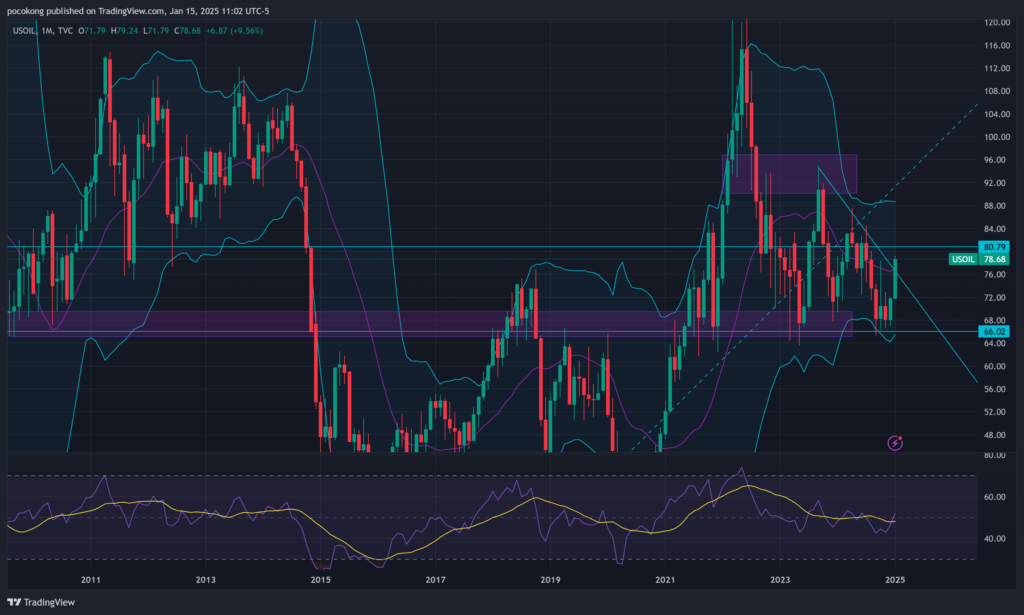
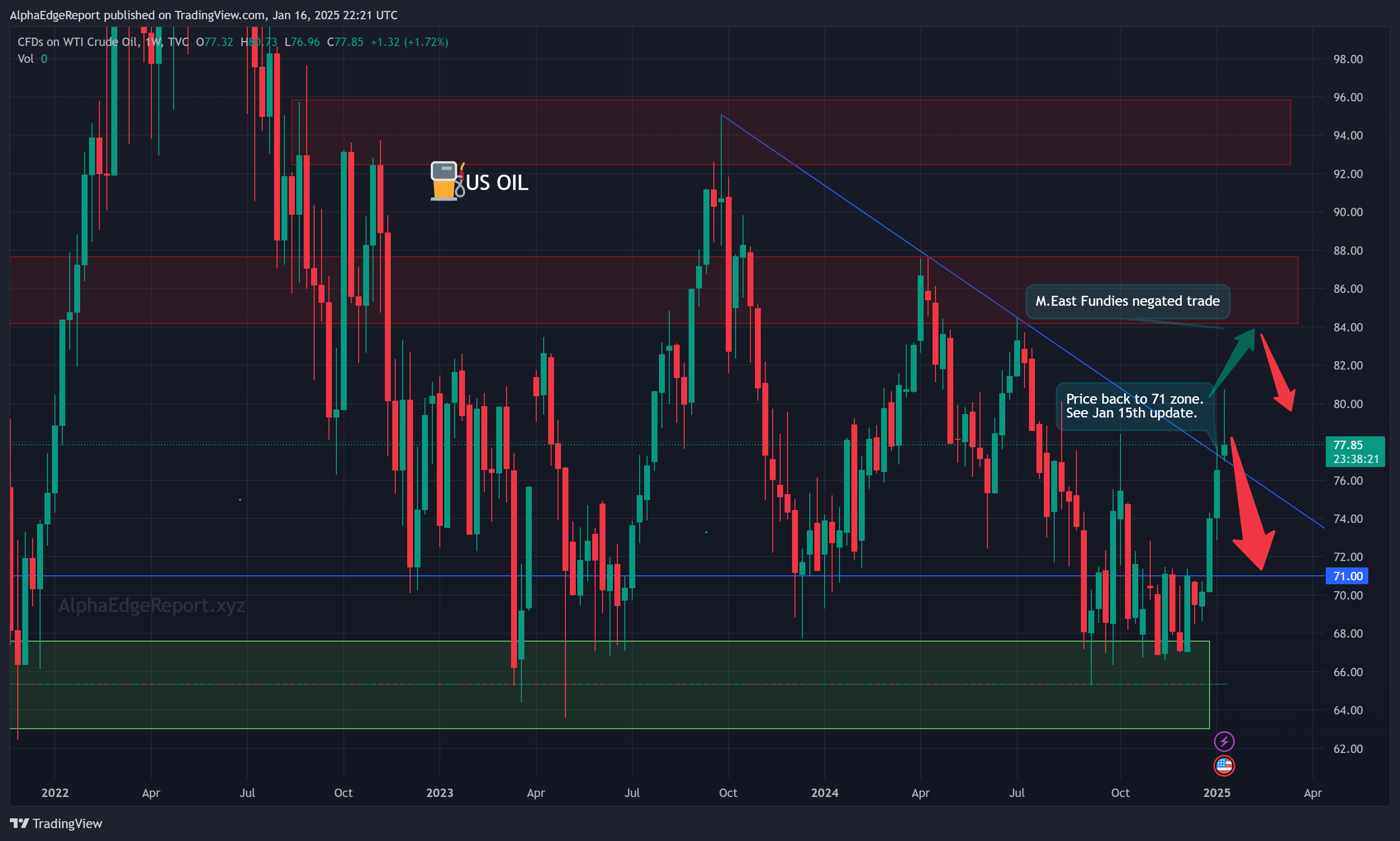
    While prices briefly surpassed $80 per barrel (see our Jan 15th update), they failed to maintain this level, with Middle East geo-political developments halting further advances toward $84. Bearish sentiment now focuses on key support levels at $76 and $71.

  • US OIL Update January 15th, 2025

    US OIL Update January 15th, 2025

    With today’s Core CPI printing at 0.2%, cooler than expected, markets may interpret this as the FED pausing rate hikes for now. However, is this enough to dampen the prevailing narrative and curb discussions of further rate increases? While it doesn’t provide a clear green light for a “risk-on” environment, markets reacted positively. Stocks soared, and banks reported strong earnings.

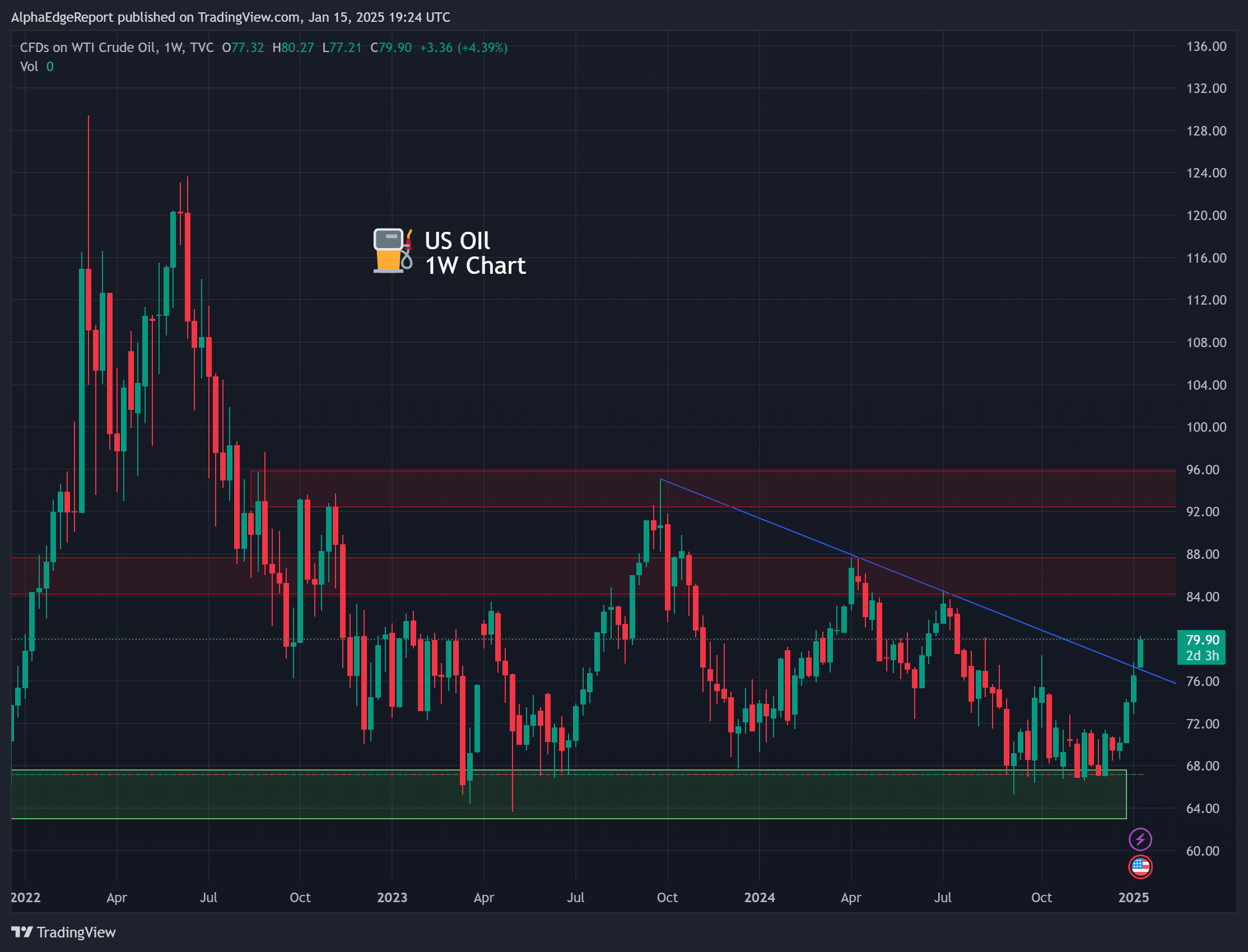
    US oil prices followed suit, with the weekly downtrend channel resistance currently being tested. Near-term factors, as outlined in our Alpha Edge Report (Jan 13), continue to support the daily bullish case. Notably, oil remains within a monthly consolidation triangle, with key support at $66. Both the monthly and weekly RSI momentum indicators are bullish. Price has already closed above the daily resistance level of $78 on the 4H chart. A daily close above this level would shift the focus to the next target of $80. We remain bullish on oil in both the near and mid-term outlooks.

    Trading Strategy

    Ideally, we would prefer a retracement to the low $75 range, as entering long positions from $76–$78 offers limited value. Having exited our previous long trade from $68 to $75, we remain sidelined for now. Our next entry will be contingent on a strong bullish daily close above $79.24.

    Key levels to watch:

    For bulls: $80, $84, $85, and $88.

    For bears: $76 and further down to $71.

  • Market Volatility Increases Pre Inflation Data

    Market Volatility Increases Pre Inflation Data

    A Market on Edge

    Following the Non-Farm Payrolls (NFP) report on January 10, 2025, financial market sentiment has shifted notably. U.S. Treasury yields surged as investors reacted to stronger-than-expected job growth, raising concerns about persistent inflation and the Federal Reserve’s interest rate policies. In the UK, investor sentiment turned negative due to rising gilt yields linked to specific fiscal challenges and inflationary pressures from recent budget measures. Overall, markets are bracing for potential volatility as economic data influences central bank strategies amid a backdrop of heightened uncertainty.

    Post-NFPs on January 10, 2025, the stock market reacted negatively despite positive job growth data. Investors reassessed the likelihood of central bank rate cuts, leading to higher government bond yields, particularly affecting high-valuation sectors like technology. The Nasdaq fell by 2.3%, while defensive sectors like utilities performed better. Overall, the Dow Jones and S&P 500 also declined by 1.9% each, reflecting a cautious outlook as markets adjusted to the implications of the labor report on monetary policy expectations.

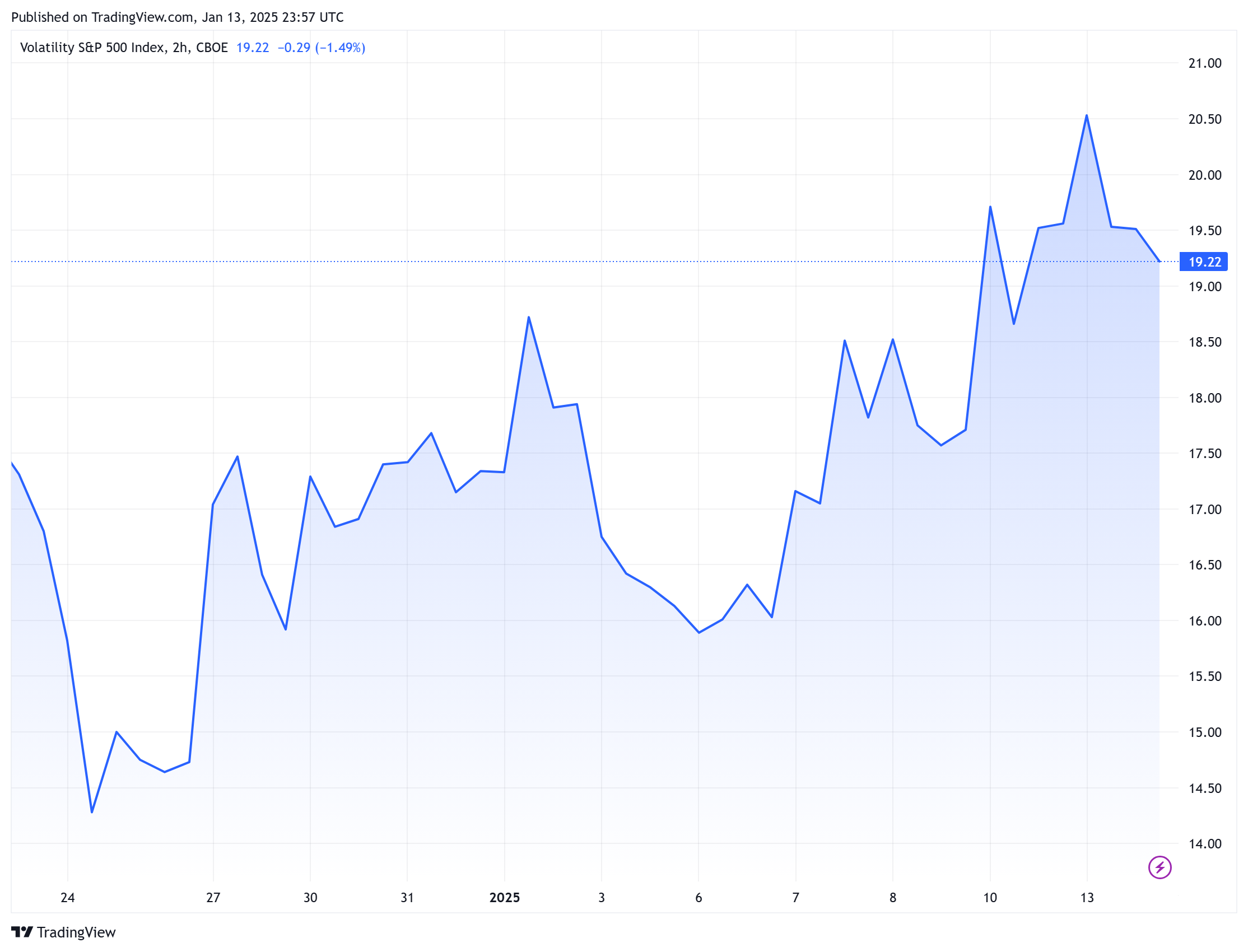
    As of January 13, 2025, the CBOE Volatility Index (VIX) is at 19.54, having increased by 8.1% from the previous day. This rise indicates heightened market volatility expectations, often referred to as the “fear gauge.” A VIX level above 20 typically suggests increased uncertainty among investors regarding future market movements. Therefore, the current VIX reading indicates a notable level of anticipated volatility in the market today.

    Sector Spotlight: Oil, Gold, and Crypto

    After the January 10th Non-Farm Payrolls (NFP) report, which indicated a stronger-than-expected job growth of 256,000, sectors like oil, gold, and crypto experienced notable movements:

    • Oil: Prices surged, reaching four-month highs due to increased demand and inflation concerns. Some market commentators noted that this positive trend was supported by expectations of economic growth in China and rising winter fuel demand. However, US pressure on Iran remains a dominant narrative, translating to a near-term bullish case for oil.
    • Gold: The performance of gold remained buoyant but contained within its weekly consolidation triangle, acting as a weak hedge against oil market fluctuations.
    • Crypto (Bitcoin): We continue to see Bitcoin as a risk asset rather than a safe haven. Thursday’s sell-off and muted bounce post-NFP kept Bitcoin within its weekly consolidation range of 91,000 – 104,000.

    Forex Performance: A Dollar Surge

    Following the January 10th NFP report, the forex markets reacted significantly:

    • US Dollar (DXY): The DXY surged to its highest level since November 2022, nearing 110.00, driven by strong job growth and reduced expectations for Fed rate cuts in 2025.
    • EUR/USD: The euro weakened against the dollar, approaching multi-year lows and parity as the dollar’s strength overshadowed any positive domestic data from Europe.
    • USD/JPY: The USD/JPY pair saw modest gains, reflecting expectations of potential policy shifts from the Bank of Japan due to strong US labor market data.

    Looking Ahead: CPI Inflation Data

    Analysts are cautiously optimistic about market performance in the coming days, particularly with the upcoming CPI inflation data. Expectations are for modest inflation, with forecasts suggesting a CPI of around 2.4% for 2025, down from 2.9% in 2024.

    The strong labor market could bolster the US dollar further, impacting forex rates like EUR/USD and USD/JPY negatively. In the stock market, analysts predict continued gains but at a slower pace than in 2024, with a projected S&P 500 target of 6,500, reflecting a roughly 9% increase. However, potential inflationary pressures from incoming policies could introduce volatility.

    Trading Strategies

    Indices

    • SPX Weekly up-trend still intact. Price is currently at dynamic support with the 25 EMA and mid Bollinger Band circa 5827. If the CPI print comes in unfavourably, we see price targeting support around 5650 just off the 50 EMA. Near term BEARISH. Long term BULLISH.
    • NASDAQ Long term up trend intact as long as we remain above 18000. As last week’s market moves continue we see price holding at dynamic support around 26800 — 50 EMA and mid Bollinger Band. However divergence on the weekly RSI is more prominent. Underlining the near term bearish case as momentum fades. Near term BEARISH. Long term BULLISH.

    Commodities

    • US OIL Weekly down trend intact. But previously mentioned near term factors maintain the daily bullish case. Note OIL is still contained within a monthly consolidation triangle with support at 66. Monthly and weekly RSI momentum is bullish. Price has already closed above daily resistance at 78 on the 4H chart. A daily close above this level brings the next target of 80 in focus. We remain BULLISH on OIL near term and mid term.
    • Gold: As already mentioned, GOLD’s performance remains buoyant, but contained within its weekly consolidation triangle. Near term support is 2600 and resistance at 2730. Price is at multi-year highs we see it remaining BULLISH long term with continued market uncertainty and volatility. Near term RANGE BOUND as price navigates this weekly consolidation.
    • Crypto (Bitcoin): Again, Thursday’s sell off and muted bounce post NFPs, kept BItcoin within its weekly consolidation range of 91,000 – 104,000. We have been monitoring this consolidation pattern in BTC and altcoins since mid-December. Failure to maintain 104,000 and strong RSI divergence have kept us bearish. Next targets for BTC is 80,000. Above the last consolidation and dynamic supports 50 EMA and mid Bollinger. Near term BEARISH. Long term BULLISH.

    Forex

    • US Dollar (DXY): Dollar holla. As noted in our post NFP summary above, USD remains strong across the board. Price and RSI momentum are bullish on all charts including weekly and monthly with healthy pullbacks. Price is on course for all time highs at 114. Near term BULLISH. Long Term BULLISH.
    • EUR/USD: Again multi-year lows and parity in sight with USD strength. Near term BEARISH. Long term BEARISH.
    • USD/JPY: The pair is at multi-year highs and the only negative we see is possible near term consolidation as price looks to attack at high 161s. Weekly range. Support 140.50 to 160 resistance. So as RSI momentum drops, buy any dips. Near term RANGE. Long term BULLISH.
  • Market Caution Amid Tech Selloff, Inflation Fears & Oil Volatility January 8, 2025

    Market Caution Amid Tech Selloff, Inflation Fears & Oil Volatility January 8, 2025

    Market Pulse: Navigating the Turbulence of January 8, 2025

    As the financial markets kicked off the second week of 2025, the mood among investors could best be described as cautious. The year had barely begun, yet volatility seemed to have already made itself at home. The source of the jitters? A sharp selloff in the tech sector, lingering inflation fears, and rising Treasury yields.

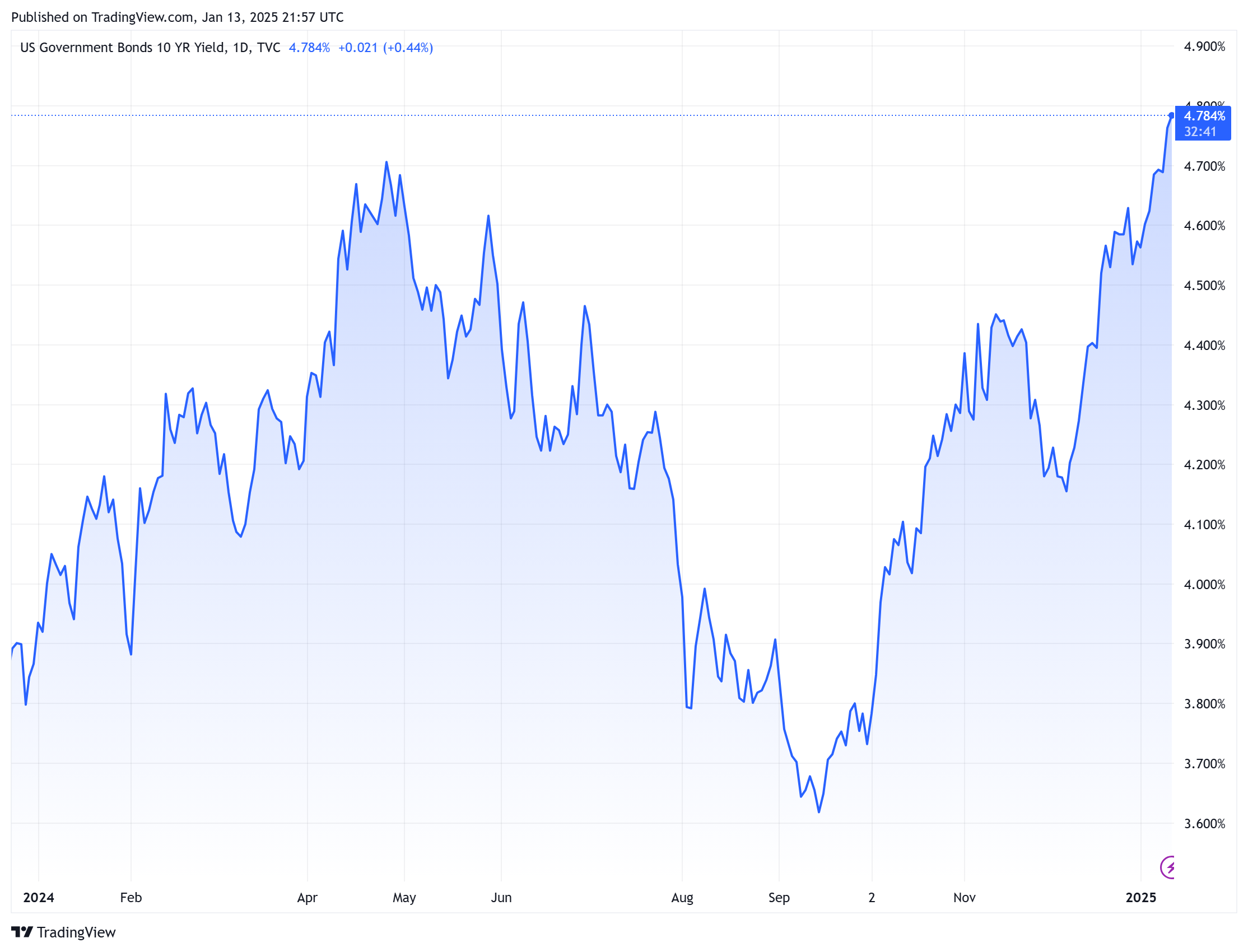
    On this particular day, futures for the Dow Jones and S&P 500 edged lower, reflecting investor anxiety. With the Federal Reserve signaling a 95% likelihood of maintaining its current rate policies, hopes for a near-term pivot were all but extinguished. Treasury yields, climbing past 4.7%, underscored persistent inflation concerns and left traders bracing for another rocky session. Adding to the suspense, critical job market reports and the release of Federal Reserve meeting minutes were on the day’s agenda.

    Tech Takes a Hit

    The tech-heavy Nasdaq bore the brunt of investor unease on January 7. A strong ISM services index reading hinted at continued economic expansion and, alarmingly, rising prices. For inflation-wary investors, this spelled trouble. Concerns swirled that the Federal Reserve might maintain its hawkish stance on interest rates, keeping borrowing costs elevated and dampening growth.

    Big names in tech took a beating. Nvidia plummeted 6.2%, while Tesla slid 4%. These declines dragged the Nasdaq down nearly 2%, sending ripples across the broader market. The selloff served as a stark reminder that even giants are not immune to the broader economic narrative.

    Commodities Hold Their Ground

    While the tech sector stumbled, commodities painted a more nuanced picture.

    Oil: Early in the week, crude prices enjoyed a modest rally, buoyed by optimism surrounding economic recovery in the U.S. and China. Brent crude reached $75.48 per barrel, and WTI climbed to $72.44. Supply constraints from OPEC and weather disruptions in key production regions lent additional support. But the tide turned on January 7. A strengthening U.S. dollar, coupled with concerns about oversupply from non-OPEC producers, reversed earlier gains. Bearish inventory data added fuel to the fire, sending crude prices lower.

    Metals: Gold shone brightly amid the uncertainty, with prices surging to $2,650 per ounce. The metal’s safe-haven appeal drew strong demand from investors seeking shelter from inflation and economic volatility. Copper and aluminum held steady, supported by favorable financing conditions for gold-related projects.

    Cryptocurrency: Despite some volatility, the crypto market proved its resilience, delivering a generally positive performance. Bitcoin and Ethereum led the charge, buoyed by expectations of lower interest rates and optimism around Bitcoin ETFs. Whilst some may view this asset class as an inflation hedge, we still view the sector as highly speculative.

    What’s Driving Oil Prices?

    The rise and fall of oil prices during this period illustrate how complex and interconnected the energy market can be. Early optimism was driven by strong economic data from the U.S. and China, which suggested higher energy demand as their economies recovered. OPEC’s production cuts further tightened supply, while geopolitical tensions and weather-related disruptions added risk premiums to prices.

    Yet, the market’s mood shifted as quickly as a change in the wind. On January 7, oil prices stumbled in response to a stronger U.S. dollar and concerns over rising supply. Reports of increased production from the U.S. and other non-OPEC countries introduced the specter of oversupply, while weaker economic data from Germany hinted at slower demand growth. By the end of the day, the once-promising rally had turned into a selloff.

    The Road Ahead

    Looking forward, analysts are sounding a note of caution. While U.S. equities have shown resilience in the face of elevated valuations, the road ahead is far from smooth. Inflation remains a pressing concern, and any hints of further rate hikes from the Federal Reserve could unsettle markets.

    Sectoral dispersion will likely define the coming days, with some areas offering opportunities while others falter. Technology, in particular, will remain a focal point, as investors weigh the sector’s growth potential against the broader economic backdrop.

    For commodities, the balance between supply constraints and demand optimism will continue to shape the narrative. Meanwhile, cryptocurrency traders will keep a close eye on regulatory developments and market sentiment, hoping for another leg up in this volatile space.

    In a market defined by uncertainty, staying informed and adaptable is more important than ever. As the trading year unfolds, one thing is clear: 2025 is shaping up to be anything but predictable.

    To navigate these unpredictable waters effectively, make sure you’re equipped with the latest insights and analysis. Subscribe to our blog today for expert commentary, market updates, and strategies that can help you stay ahead of the curve. Don’t miss out on valuable information that could make all the difference in your trading and journey!

    Visit our Instagram for the audio summary.

  • Welcome to the Alpha Edge Report

    Happy new year Alpha Edge readers!

    Welcome to the new Alpha Edge Report, your go-to blog and newsletter for insights into the dynamic world of macro trading and investing. As we navigate the complexities of today’s markets, characterized by heightened volatility and shifting economic landscapes, our mission is to uncover opportunities amidst uncertainty.

    In this era, where traditional low-inflation trends are fading, macro strategies are poised to thrive. We’ll explore how these strategies can help you capitalize on emerging trends, enhance diversification, and navigate the evolving financial environment. Join us as we embark on this journey to gain a competitive edge in macro investing!

    I hope you all enjoyed the holidays and are ready for 2025 in the markets, there’s some big things on the horizon. Interesting times indeed.

    There’s been some focus back on the UK’s unstable Gilt market, but the main focus of on every investor’s mind, the U.S.

    Let’s get into the first report of 2025!

    Subscribe to our blog today for expert commentary, market updates, and strategies that can help you stay ahead of the curve.

Review Your Cart
0
Add Coupon Code
Subtotal

 
×